2024.08–2026.08. Postdoctoral Associate, Department of Anesthesiology, Weill Cornell Medicine, New York, USA. Mentor Jyun-you Liou. Synchronized recording and analysis of multimodal neural signals.
2022.12–present. Associate Professor, Institute of Computer Vision, College of Computer Science and Technology, Zhejiang University of Technology. Doctoral supervisor (academic degree programs) since 2023.
2018.08–2019.08. Visiting Scholar, Imaging Research Division, Department of Radiology, University of Pittsburgh, USA. Mentor Shandong Wu. Intelligent understanding of medical images.
2014.07–2022.12. Lecturer, Institute of Computer Vision, College of Computer Science and Technology, Zhejiang University of Technology.
2013.08–2013.10. IBM Research China, Shanghai. Internet of Vehicles project group, big-data algorithms for connected vehicles.
2009.09–2014.07. Shanghai Institute of Microsystem and Information Technology, Chinese Academy of Sciences. Combined master's and doctoral program in Communication and Information Systems, Ph.D. in Engineering conferred by the University of Chinese Academy of Sciences. Advisor Xiaobing Yuan.
2005.09–2009.07. Hangzhou Dianzi University. B.Eng. in Communication Engineering.
Qianwei Zhou, Ph.D., is an Associate Professor and doctoral supervisor in the College of Computer Science and Technology at Zhejiang University of Technology (ZJUT). Zhou studies robust representations of multimodal neural and medical signals. The current focus is robust feature extraction from the electroencephalogram (EEG) under multimodal constraints.
The research is organized around one question. Why does a model fail when the subject, the recording device, or the recording session changes, and how can that failure be prevented? Observations of complex systems commonly carry three defects. Acquisition cannot be fully controlled, so sensor damage, occlusion, and disconnection produce missing data. The structure of the system is highly dynamic, so the regions observed by different modalities do not line up in space, which produces channel misalignment. The state of the system fluctuates strongly over time, so data from different subjects and sessions differ in their statistics, which produces distribution shift. Existing methods compensate for these defects with manual preprocessing, namely manual rejection of bad samples, manual registration, and manual normalization. However, the preprocessing parameters fit only the data they were tuned on, so a system stops being reliable as soon as it leaves its original setting. Zhou's position is that manual preprocessing limits robustness. The handling of all three defects should instead be built into the model itself, so that the space in which the model represents its input, referred to below as the latent space, does not change with acquisition conditions. Zhou's early work used sensing signals such as acoustic arrays, seismic vibration, and geomagnetic fields. The work then moved to medical imaging, and in recent years it has concentrated on multiscale neural signals, including EEG, electrocorticography (ECoG), and neural calcium imaging.
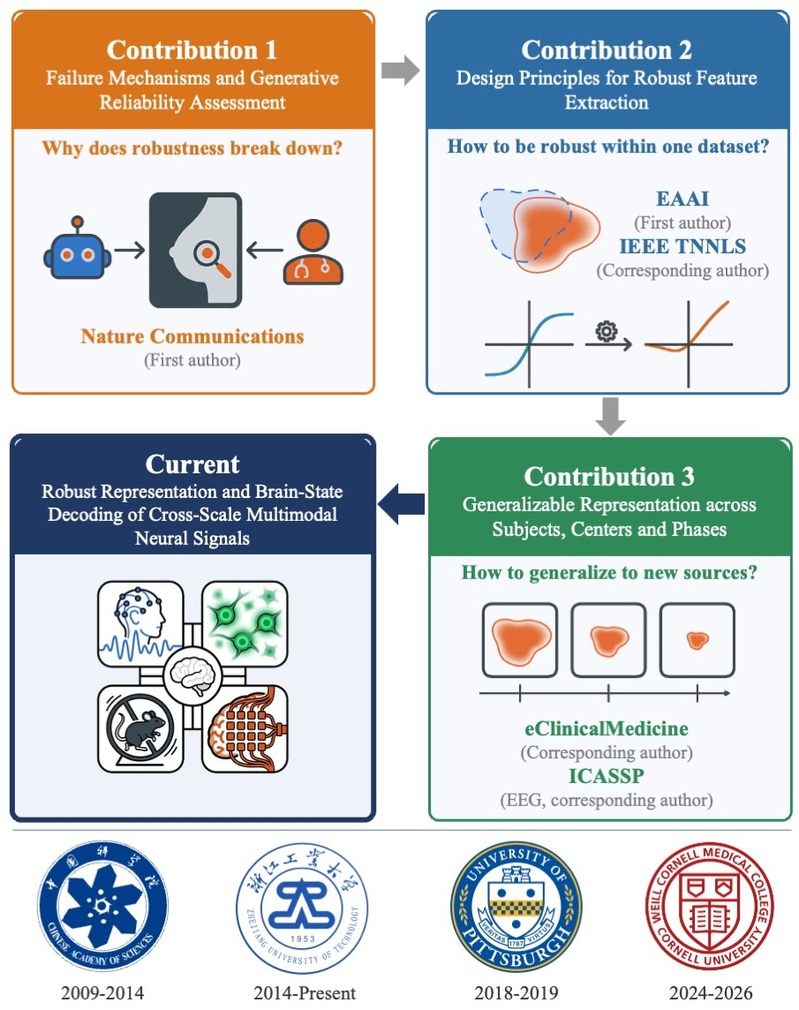
Four representative results answer four successive questions along one chain. The first asks why the latent space is not robust. The second asks how a network should be designed to extract a robust latent space within one dataset. The third asks how the latent space can stay stable when the data source and the acquisition time change. The fourth asks how it can stay stable when the subject changes. The cause of a failure must be understood before a design can target it, and features must be stable within one data domain before stability across domains becomes meaningful. These two dependencies fix the order of the four results.
Result 1. Why the latent space is not robust. A reader study that Zhou published as first author in Nature Communications (2021) gave the answer, which is that deep representations lack structural constraints. The study used a generative adversarial network (GAN) to modify only the lesion region of breast images, keeping all other tissue identical pixel by pixel, and then compared how artificial intelligence (AI) models and radiologists read these images. If a model truly judged a lesion by its structural relation to the surrounding tissue, its output should change when the lesion appears at an anatomically impossible location. The experiment showed the opposite. The participating radiologists pointed out that some synthetic images placed lesions in regions where no breast tissue should exist, yet the diagnostic models scored these images just as they scored real ones. It follows that the models' latent space does not encode anatomical structure. The work also established a reusable evaluation principle. A generative model constructs semantically controlled counterfactual samples, and the model's responses to those samples measure which information its latent space actually relies on. The work was presented orally at the 2019 Annual Meeting of the Radiological Society of North America (RSNA), and its follow-up direction is funded by a General Program grant from the National Natural Science Foundation of China (NSFC).
Result 2. How to extract a robust latent space within one dataset. Because the failure comes from missing structural constraints, robustness should be built into the network design, so that the network itself learns features that withstand perturbation. In a feed-forward feature extractor, the designer controls only three components, namely the architecture, the activation function, and the loss function. The representative result is a layer-wise adaptive activation function method, published by Zhou as corresponding author in IEEE Transactions on Neural Networks and Learning Systems (2023). It determines each layer's activation function automatically from the network structure and the target task, instead of applying one hand-picked function throughout the network. For the other two components, Zhou proposed, as first author, the redundant and missing feature decoupling network RMFDNet (Engineering Applications of Artificial Intelligence, 2025) and a non-binary intersection-over-union (IoU) loss (Expert Systems with Applications, 2023). Channel misalignment mixes information from different locations into one feature channel and creates redundant components, whereas missing channels leave expected information empty and create missing components. The two have opposite causes, so RMFDNet separates them explicitly and treats each one on its own. The non-binary IoU loss gives correct gradients in regions with continuous values, such as object edges. This line of work goes back to Zhou's early robust feature extraction for seismic signals (IEEE Signal Processing Letters, 2012). At that time, features that resist noise and deformation were designed by hand. Now the rules that let a network learn such features are designed by hand.
Result 3. How the latent space stays stable across data sources and acquisition times. The first two results stabilize the latent space within one dataset. The real test is whether that stability survives a change of data source and acquisition time. Zhou is a co-corresponding author, and the only corresponding author from computer science, of a multicenter study in eClinicalMedicine (published by The Lancet, 2025). The study predicts the response of breast cancer to neoadjuvant chemotherapy early and noninvasively. A Siamese network extracts dynamic contrast-enhanced magnetic resonance imaging (MRI) features at two time points, before chemotherapy and early in chemotherapy, and a Transformer-based multi-head attention module models the spatiotemporal interaction between the two time points. The study enrolled 1044 patients from 5 medical centers. On 3 external validation cohorts, the area under the receiver operating characteristic curve (AUC) was 0.892–0.923. In two public cohorts independent of the training data (I-SPY1 and I-SPY2), the cases that the model predicted as good responders showed upregulated immune-related genes and stronger immune cell infiltration. This indicates that the latent space of macroscopic images captured microscopic biological processes related to treatment response, rather than fitting one particular dataset.
Result 4. How the latent space stays stable across subjects. EEG signals differ markedly between individuals, and the failure to generalize across subjects is a bottleneck that keeps brain-computer interfaces (BCIs) from practical use. As corresponding author, Zhou proposed a masked self-supervised contrastive learning framework for EEG motor imagery at the 2025 IEEE International Conference on Acoustics, Speech and Signal Processing (ICASSP). Its three components correspond one to one with the three data defects. Manifold-aware masking simulates missing data, domain alignment handles channel misalignment, and multi-view spatiotemporal attention handles distribution shift. With scarce labels, the framework still generalized across subjects better than the supervised baseline.
From the four results to the current direction. Result 3 checked the latent space of macroscopic images against microscopic molecular and cellular evidence after training, and the two agreed. From August 2024 to August 2026, Zhou was a postdoctoral researcher at Weill Cornell Medicine and took part in synchronized recordings of mouse cortex with widefield calcium imaging, two-photon calcium imaging, and transparent ECoG electrode arrays. As co-first author, Zhou completed a cross-scale cortical electrophysiology study (bioRxiv preprint) in which the synchronized recordings directly showed a correspondence between microscopic population neural activity and macroscopic field potentials. Because this correspondence exists, there is no need to wait until training ends to check it. Instead, microscopic neural activity can constrain the EEG latent space directly during training. This is Zhou's current research direction, robust EEG feature extraction under multimodal constraints. In practical BCI use only EEG is available, so the cross-scale constraint acts as a regularizer during training only, and inference needs no microscopic recordings.
Zhou has published or had accepted more than 80 papers, with 2076 Google Scholar citations, an h-index of 20, and an i10-index of 36. Zhou has led one NSFC General Program grant and one NSFC Young Scientists Fund grant, and holds 20 granted Chinese invention patents as first inventor, 4 of which have been transferred to industry. During doctoral study, Zhou received the National Scholarship for Doctoral Students, the President's Excellence Award of the Chinese Academy of Sciences, and the institute director's first-class scholarship. In 2023, Zhou was selected as a Category D talent in the ZJUT 14th Five-Year High-Level Talent Development Program.